
EP 369 - [EON] Hiding in Plain Sight: AI and Software Costs | Paper Napkin Wisdom
Updated: Aug 10
Some of the biggest opportunities in business do not look like opportunities at first.
They look like invoices.
They look like renewals.
They look like software platforms everyone complains about, but nobody questions anymore.
That is the tension at the center of Episode 368 of Paper Napkin Wisdom, which is also #39 in the Edge of the Napkin series. In this solo episode, Govindh Jayaraman explores a shift that every proven entrepreneur should be paying attention to now: AI is starting to expose the cost and fragility of expensive enterprise software.
Not all of it.
Not the mission-critical spine of the business.
But the extra layers.
The add-ons.
The reporting modules.
The document tools.
The workflow pieces.
The customer communication functions.
The things that used to cost a lot because, at the time, there was no other way to get them.
The Real Question Leaders Should Be Asking
The question is not, “Can AI replace my software?”
That question is too broad.
The better question is: What are we still paying for because five years ago there was no other way to get it?
For a proven entrepreneur, that question has weight. A business that has been built over 8, 12, or 20 years has accumulated decisions. Some were brilliant at the time. Some were necessary at the time. Some became habits.
Software often falls into that last category.
A system gets bought. The team adapts. The business grows around it. The contract renews. The pain becomes normal.
Then one day the business is paying thousands, sometimes tens of thousands, for a platform that no longer creates the value it once promised.
Why This Matters Now
AI is not just changing the tools leaders use. It is changing the value structure underneath software itself.
Reuters reported in February 2026 that U.S. software and data services companies had lost roughly $1 trillion in market value over a week as investors worried that fast-moving AI tools could disrupt the sector. The same report noted pressure on major names like ServiceNow, Salesforce, and Microsoft during that selloff. (Reuters)
That does not mean traditional software disappears.
It does mean the market is asking a harder question.
What part of the software stack is still defensible?
The answer may be uncomfortable for some vendors. AI is beginning to move into functions that used to be sold as expensive modules. Reporting. Search. Drafting. Analysis. Knowledge retrieval. Support. Internal workflow.
A company that once charged a premium for a specialized layer may now be competing with an AI-supported tool that does 70% of the job for a fraction of the cost.
For leaders, that is not a theory.
That is a margin opportunity.
The Economy Is Adding Pressure
This is happening while the broader economy remains uneven.
The Bank of Canada has described the Canadian economy as growing at a moderate pace while adjusting to U.S. tariffs, with inflation pressures affected by higher oil prices and global conflict. (Bank of Canada) Statistics Canada reported that real GDP declined 0.2% in the fourth quarter of 2025 after growth in the previous quarter. (Statistics Canada)
That matters because software companies are not immune to the same pressures their customers face.
When buyers get more cautious, sales slow.
When investors expect the old growth curve, pressure rises.
When AI begins replacing pieces of the value proposition, sales teams miss quotas.
Then customer success teams get stretched.
Support gets thinner.
Implementation gets slower.
Product teams rush to add AI features.
Customers feel it as friction.
The vendor may still have a good product. The people may still care. The system may still matter.
But pressure travels.
Eventually, it lands on the customer.
The Common Mistake
Most leaders look at AI as a productivity tool.
They ask if it can help write emails, summarize meetings, draft proposals, or speed up marketing.
Those are useful questions.
They are not the biggest questions.
The bigger opportunity may be hiding in cost structure.
Govindh Jayaraman makes the point clearly in this episode: the opportunity is not to chase AI because it is new. The opportunity is to use AI as a lens to see what has become bloated, stale, or unexamined.
That is a very different posture.
It is not reckless replacement.
It is disciplined attention.
The proven entrepreneur cannot afford chaos. There are real teams, real customers, real workflows, and real consequences. But that same entrepreneur also cannot afford to treat old decisions as permanent.
AI Is Not the Spine. It May Be the Layer Around the Spine.
Some systems are still essential.
They hold customer records.
They manage billing.
They connect field operations.
They track inventory.
They support compliance.
Those systems should not be casually removed.
But many expensive platforms include layers around the core system that may now be open to challenge.
A reporting layer.
A proposal tool.
A training module.
A customer communication function.
A knowledge base.
A dashboard that looks useful but is rarely trusted.
If people still export the data into spreadsheets before making decisions, that is a clue.
If the team still asks the same questions because nobody can find the answer in the system, that is a clue.
If the software requires more workarounds every year, that is a clue.
AI may not replace the platform.
It may replace the parts of the platform that no longer earn their place.
Five Key Takeaways from Episode 368
1. Software Spend May Be Hiding Your Next Margin Opportunity
Most leaders know their payroll costs. They know their rent. They know their major vendor relationships.
But software can become invisible because it feels operationally normal.
That makes it dangerous. Not because software is bad, but because unexamined software spend becomes a quiet tax on the business.
Take Action: Pull the top ten software costs in the company and ask one question beside each one: “What business value does this create today?”
2. AI Should Be Tested Against Specific Workflows, Not Entire Systems
Replacing a whole platform is risky.
Testing one workflow is leadership.
A report. A proposal process. A customer update. A training response. A recurring internal question.
That is where the work should begin.
Take Action: Choose one low-risk workflow and run a 30-day comparison between the current process and an AI-supported alternative.
3. Vendor Pressure Eventually Becomes Customer Friction
When enterprise software companies face slower growth, investor pressure, and AI disruption, customers often feel the effects.
Support slows down.
Pricing changes.
Renewals get harder.
Product direction gets confusing.
That does not make the vendor bad. It means the leader should stop assuming the experience will stay the same.
Take Action: Track support quality, response times, renewal pressure, and product changes from your largest software vendors.
4. The Safest Move Is Not Waiting
Waiting can feel safe because nothing breaks today.
But waiting also preserves the current cost structure.
The leader does not need to make a dramatic move. The leader needs to begin.
The most dangerous sentence in a business may be, “That’s just what we use.”
Take Action: Ask the leadership team, “What are we paying for because we stopped questioning it?”
5. This Is a Leadership Attention Issue Before It Is a Technology Issue
AI is not the hero of this episode.
Attention is.
The real leadership move is the willingness to look at old decisions with fresh eyes. That requires confidence. It requires calm. It requires congruence between what the business says it values and what it continues to fund.
Contribution matters too. If AI frees margin, time, or energy, the question becomes how that freed capacity serves the business, the team, and the customer better.
Take Action: Pick one software renewal coming up in the next 90 days and require a value review before approving it.
The Napkin Moment
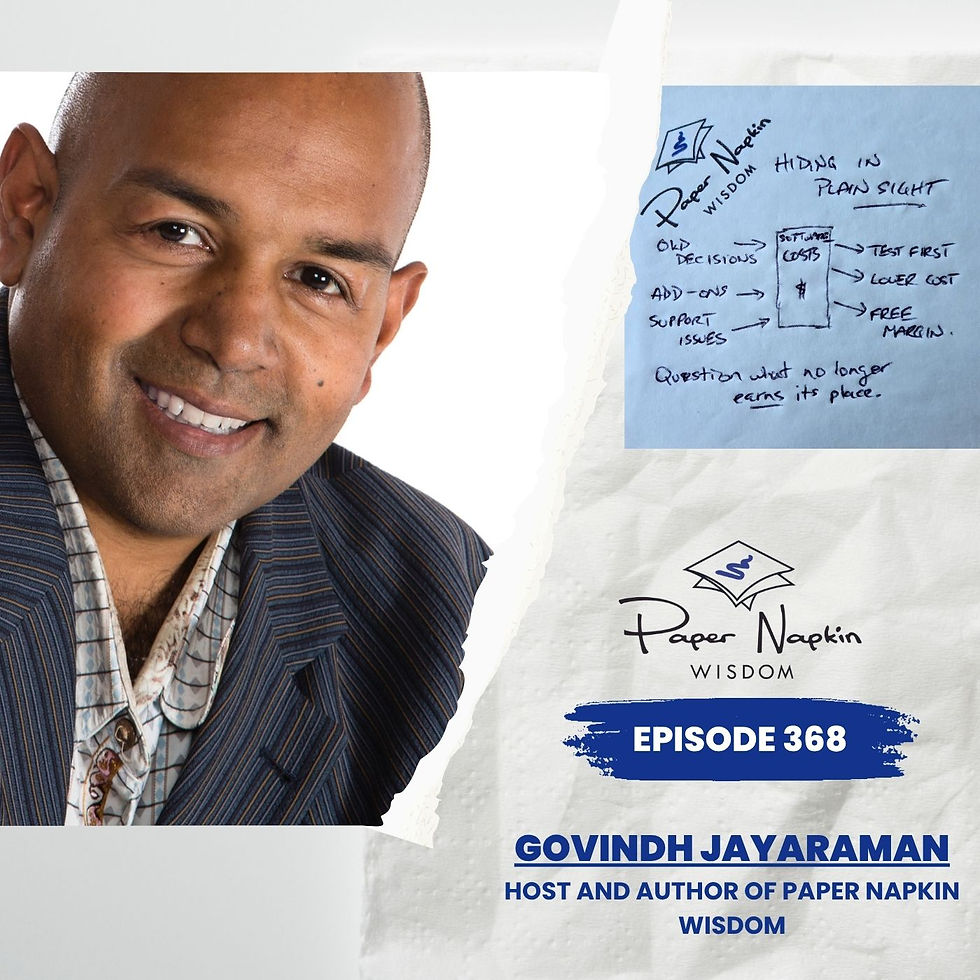
If Govindh Jayaraman had to write this episode on a napkin, it might read:
Question what no longer earns its place.
The sketch is simple.
In the center, a box labeled “Software Costs.”
On the left side, arrows feeding into the box: old decisions, add-ons, support issues.
On the right side, arrows coming out: AI opportunity, test first, lower cost, free margin.
At the bottom: “Question what no longer earns its place.”
That is the whole episode in one image.
Not “replace everything.”
Not “trust every AI tool.”
Not “panic because the world is changing.”
Just this: look again.
Closing Reflection
Some opportunities do not arrive with noise.
They do not show up as new markets or bold strategies or dramatic reinventions.
Sometimes they arrive as the invoice you have approved for years.
Sometimes they arrive as the system everyone works around.
Sometimes they arrive as the renewal notice nobody wants to question.
What if the next meaningful improvement in your business is already sitting in the books?
🎙️ Listen to Episode 368 of Paper Napkin Wisdom:
▶ Apple Podcasts: https://podcasts.apple.com/us/podcast/paper-napkin-wisdom-leadership-entrepreneurship-insights/id735345903
▶ YouTube: https://www.youtube.com/@papernapkinwisdom
This is Edge of the Napkin #39, Govindh Jayaraman’s solo series inside Paper Napkin Wisdom.
And if this resonated, write it on a napkin.
Share it.
Tag it #PaperNapkinWisdom.
Because ideas small enough to fit on a paper napkin are often large enough to change your world.


Comments