
EP 370 - [EON] Leadership Identity: Why Copied Traits Stop Working Under Pressure
Updated: Aug 10
Some traits look powerful from the outside.
Discipline. Calm. Confidence. Consistency. Courage.
So leaders copy them.
They copy the routine. The language. The preparation. The posture before the meeting. The pre-game ritual. The way someone else enters a room.
Sometimes that is where learning starts. There is nothing wrong with studying excellence. The problem comes when the visible trait is mistaken for the source.
In Episode 370 of Paper Napkin Wisdom, and Episode 40 in the Edge of the Napkin series, Govindh Jayaraman explores a deeper question about leadership identity: what happens when a proven entrepreneur tries to copy the evidence without becoming the person it came from?
This episode is about the distance between imitation and identity.
It is about the moment when the old mask still works, but it no longer feels like your face.
The Trait Is Often Evidence, Not the Source
The central idea in this Edge of the Napkin episode is simple enough to write on a napkin:
Copied traits may not work until identity catches up.
Govindh points out that the traits we admire in champions, founders, leaders, and high performers are often not the beginning of the story. They are the evidence of something already built underneath.
Discipline may be evidence.
Calm may be evidence.
Confidence may be evidence.
Consistency may be evidence.
Courage may be evidence.
They are evidence of practice. Evidence of identity. Evidence of the lifting that happened before the result was visible.
This matters because many entrepreneurs in a chapter transition are still leading from an identity that once worked. It built the business. It earned credibility. It got applause. But somewhere underneath, something feels out of alignment.
That does not always mean the leader needs a new routine.
It may mean the identity has to catch up.
Five Key Takeaways and Take Action Steps
1. The Trait Is Not Always the Source
The traits people admire are often the evidence of identity work already done.
Discipline, calm, courage, confidence, and consistency may look like the starting point. But in leaders who carry those traits with weight, they usually came from practice that happened first.
Take Action: Choose one trait you admire in another leader. Write down what identity might be underneath it.
2. Copying the Habit Is Not the Same as Becoming the Person
A habit can be copied. A routine can be copied. A phrase, posture, or leadership behaviour can be copied.
But if the identity underneath has not changed, the behaviour may not hold under pressure. It can feel borrowed because it is still sitting on top of an older self-image.
Take Action: Look at one routine you are trying to copy. Ask whether it matches who you currently believe yourself to be.
3. Pressure Reveals the Identity Underneath
A leader can appear calm when the room is calm.
The real test comes when the number is missed, the conversation turns, or the team looks for someone to absorb the pressure. That is when the copied trait either becomes real or gets exposed.
Take Action: Think of one recent pressure moment. Write down what identity showed up in that moment.
4. Alignment Begins With Telling the Truth About the Gap
Identity work does not begin by pretending to be farther along.
It begins by seeing clearly. Where am I now? Where do I want to be? What am I copying that I have not yet made real? That kind of mirror work creates alignment without shame.
Take Action: Write two columns on a napkin. One says “Where I am.” The other says “Who I am becoming.” Put one honest sentence under each.
5. Action Gives Identity Evidence
Identity is not built by thinking alone.
Every aligned action gives the identity proof. A pause before reacting. A prepared meeting. A clean apology. A promise kept when no one is watching. These are small actions, but they accumulate.
Take Action: Choose one small action today that gives evidence to the identity you want to build. Do it, then release the outcome.
Why Copied Discipline Can Become Punishment
Discipline is one of the easiest traits to admire and one of the easiest to copy.
Wake up earlier. Work longer. Prepare harder. Stick to the plan.
But Govindh makes an important distinction. If a leader still identifies as someone who needs pressure to perform, discipline can become punishment. It may produce activity, but it does not produce peace.
That is why the question is not only, “How do I become more disciplined?”
The better question is, “Who would I have to become for discipline to feel natural?”
That question moves the work inward.
Leadership Identity Gets Exposed Under Pressure
It is easy to appear calm when nothing is happening.
It is easy to appear confident when the room already agrees.
It is easy to appear consistent when the results are visible and people are watching.
Pressure exposes identity.
A leader can copy calm. But if they still need to win the moment, calm becomes suppression.
A leader can copy confidence. But if they still need permission from the room, confidence becomes theatre.
A leader can copy courage. But if they are still trying to prove their worth, courage becomes force.
This is where leadership identity becomes practical. It is not an abstract idea. It is what people feel when the meeting turns, when the number gets missed, when the apology is needed, or when the scoreboard has not caught up yet.
Founder Clarity Begins With the Mirror
Identity work is not glamorous.
It is not a slogan.
It is not a morning routine posted online.
In this episode, Govindh brings it back to mirror work. Not the kind where someone repeats words they do not believe. The kind where they tell the truth.
Where am I right now?
Where do I want to be?
Where am I out of alignment?
What am I pretending not to know?
What am I copying that I have not yet made real?
That kind of founder clarity does not create shame. It creates clean seeing. It allows a leader to notice the gap between where they are and where they want to be without turning the gap into a verdict.
Focus, Align, Act Gives Identity Evidence
Govindh connects the episode to his Focus, Align, Act framework.
Focus begins with the identity, not just the trait. What do I want? Who am I becoming? What does that person see, feel, hear, and choose?
Align means telling the truth about the present moment. Not pretending to be farther along than you are. Not attacking yourself for where you are. Just respecting where you are relative to where you want to be.
Act is where identity gets evidence.
Every aligned action becomes proof.
Every pause becomes proof.
Every prepared meeting becomes proof.
Every honest conversation becomes proof.
Every recovery after a bad moment becomes proof.
Over time, the trait starts to feel less like performance. Less like something borrowed. Less like an impression of someone else.
It starts to become yours.
Magnetic Leadership Comes From the Inside Out
This episode also sits naturally inside Govindh’s Magnetic Leadership framework.
Confidence is not something performed. It is what happens when a leader stops outsourcing permission.
Congruence is not something announced. It is what happens when words and actions come from the same place.
Calm is not something forced. It is what happens when a leader stops needing every moment to prove their worth.
Contribution is not added at the end. It comes from seeing yourself as someone who leaves people better than you found them.
Those are not costumes.
They are expressions.
That is why two people can follow the same routine and get very different results. One is proving who they are becoming. The other is trying to look like someone else.
Teams feel the difference. Customers feel it. Families feel it. Rooms feel it.
The Napkin Moment
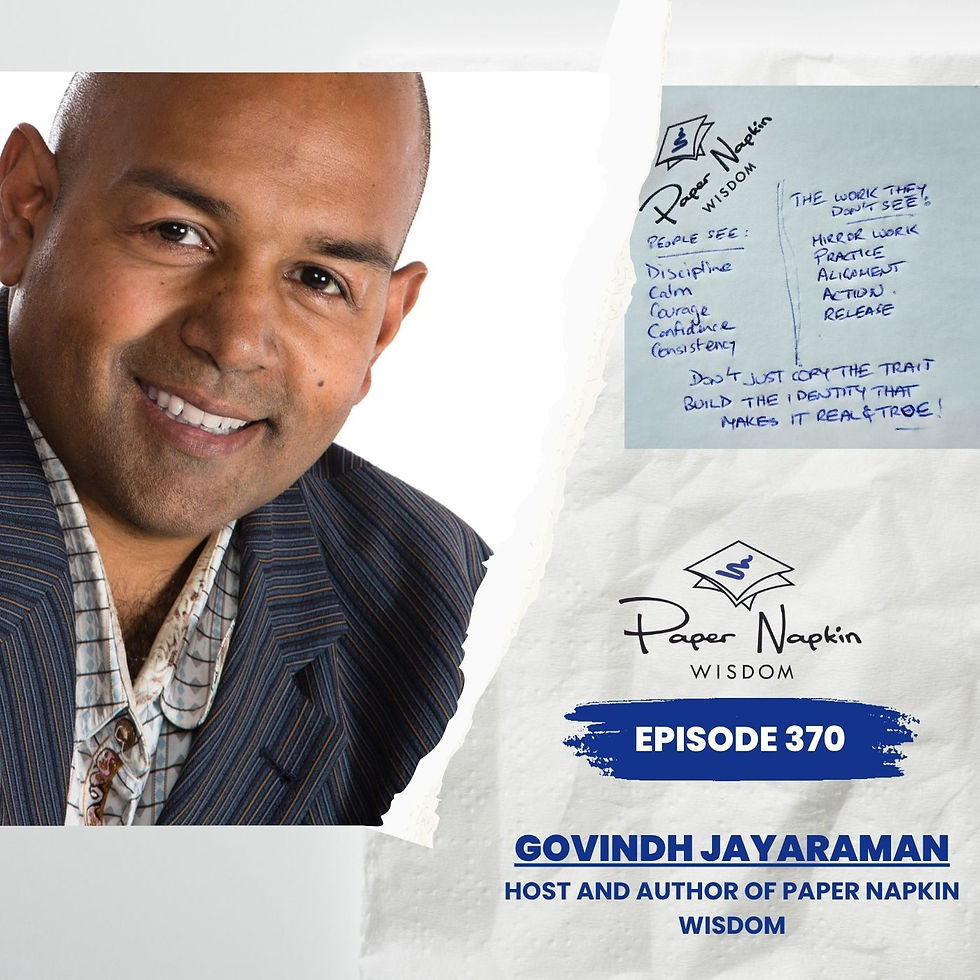
If Govindh Jayaraman had to write this episode on a napkin, it might read:
“Don’t just copy the trait. Build the identity that makes it true.”
The top of the napkin would show the trait people see: discipline, calm, courage, confidence, consistency.
Underneath would be the identity work people do not see: mirror, practice, alignment, action, release.
That is the whole episode in one image.
The visible trait is not the whole story. The unseen work gives it weight.
Why Episode 370 Matters
For the proven entrepreneur, this episode lands in a very specific place.
It is not for the beginner trying to copy success. It is for the leader who already has success, but feels the next chapter asking for a different internal structure.
The old identity may still function.
The old habits may still produce.
The old traits may still get applause.
But the next chapter may require something less visible and more honest.
Not more imitation.
More identity.
What trait have you been trying to copy that may need to be built from the inside instead?
🎙️ Listen to Episode 370 of Paper Napkin Wisdom:
▶ Apple Podcasts: https://podcasts.apple.com/us/podcast/paper-napkin-wisdom-leadership-entrepreneurship-insights/id735345903
▶ YouTube: https://www.youtube.com/@papernapkinwisdom
▶ Website: https://www.papernapkinwisdom.com
And if this resonated, write it on a napkin. Share it. Tag it #PaperNapkinWisdom.


Comments