
EP 376 - [EON] Time in Neutral: The Oldest Creativity Hack Still Works | Paper Napkin Wisdom
- Govindh Jayaraman
- Jul 5
- 5 min read
Updated: Aug 10
There is a moment before the idea comes.
It often looks like nothing.
A walk without headphones. A workout without distractions. A quiet drive. A park bench. A few minutes with coffee before the world starts pulling.
Most people rush away from that moment because it feels unproductive. But in Episode 376 of Paper Napkin Wisdom, Govindh Jayaraman reframes that quiet gap as one of the most important creative conditions a leader can create.
This is Edge of the Napkin #44, titled Time in Neutral. It is about the oldest creativity hack in the world. Not another method. Not another prompt. Not another productivity
trick.
Boredom.
But not boredom by itself.
Boredom can become negative if it is filled by fear, resentment, comparison, or old stories. The mind does not stop working when the body stops moving. It keeps building. It keeps connecting. It keeps searching.
The question is whether that search has direction.
The Core Insight: The Dots Need Room to Meet
Govindh’s central idea in this episode is simple enough to write on a napkin:
The dots need room to meet. Give them neutral.
Most entrepreneurs have no shortage of input. They have books, podcasts, videos, meetings, notes, conversations, and experience. The issue is not that they lack information. It is that the mind has not been given enough quiet to assemble what it already knows.
That is where time in neutral matters.
A leader cannot force every answer through effort. Some answers arrive after the question has been pointed in the right direction, then released. The conscious mind asks. The unconscious mind connects.
That is why some of the best ideas arrive in the shower, in the car, on a walk, during a workout, or while sitting quietly with coffee. They feel sudden, but they are not random. They are the product of a question that has been given room to keep working underneath the visible line.
Five Key Takeaways
1. Time in Neutral Is Not the Same as Wasted Time
Time in neutral looks unproductive from the outside.
That is why leaders tend to distrust it. They are trained to value visible effort. Typing. Planning. Meeting. Producing. Deciding.
But not all work is visible while it is happening. The mind often does its most important connecting when it is not being interrupted. A quiet walk, a distraction-free workout, or a few minutes on a bench can become creative work when the mind has been given a clear direction first.
Take Action: Choose one 20-minute window this week for neutral time. No phone. No audio. No new input. Give your mind one question before you begin.
2. Boredom Needs Direction
Boredom is not automatically creative.
It is an opening. And openings get filled.
If the mind enters that opening with resentment, it builds resentment. If it enters with fear, it builds fear. If it enters with comparison, it finds more material for comparison.
Positive time in neutral begins before the quiet moment. It begins with Focus. Name what you want. Give the mind a picture, a question, or a direction.
Take Action: Before your next walk, workout, or quiet drive, write one question at the top of a page. Keep it simple. “What am I really trying to create?” is enough.
3. The State You Bring Into the Question Shapes the Answer
A leader can ask the right question from the wrong state.
That matters.
If the question is carried by panic, the answer often carries panic too. If the work begins with proving, the work will feel like proving. If the mind is being chased, it does not wander well.
This is where Align becomes essential. Come back to now. Breathe. Let the question exist without demanding that the answer arrive immediately.
Positive creativity needs calm. Not passivity. Calm.
Take Action: Before entering neutral time, take one minute to breathe and say: “I am allowed to not know yet.” Then begin.
4. The Unconscious Mind Connects What the Conscious Mind Cannot Force
There is a partnership between the conscious and unconscious mind.
The conscious mind points. It names the question. It chooses the direction.
The unconscious mind connects. It links a client conversation from last week to a book from ten years ago. It remembers a line, a story, a phrase, a pattern. It brings back something that did not seem related until the mind had enough quiet to put it beside something else.
This is why creativity often feels mysterious. The work was happening before the answer became visible.
Take Action: Keep a small notebook or voice memo ready after neutral time. Do not wait for the full idea. Capture the phrase, shape, or first sentence when it arrives.
5. The First Act Is to Catch the Idea
Good ideas rarely arrive finished.
They usually arrive as fragments. A sentence. A sketch. A title. A feeling. A beginning.
The mistake is expecting the unconscious mind to deliver a completed product. It usually does not. It offers the thread. The conscious mind still has to pick up the pen.
That is where Act comes in. Not a massive action. Just the next visible proof. Write the line down. Sketch the napkin. Open the document. Record the thought.
Take Action: After your next neutral session, create one artifact. One sentence. One note. One napkin sketch. Do not judge it yet. Just catch it.
The Napkin Moment
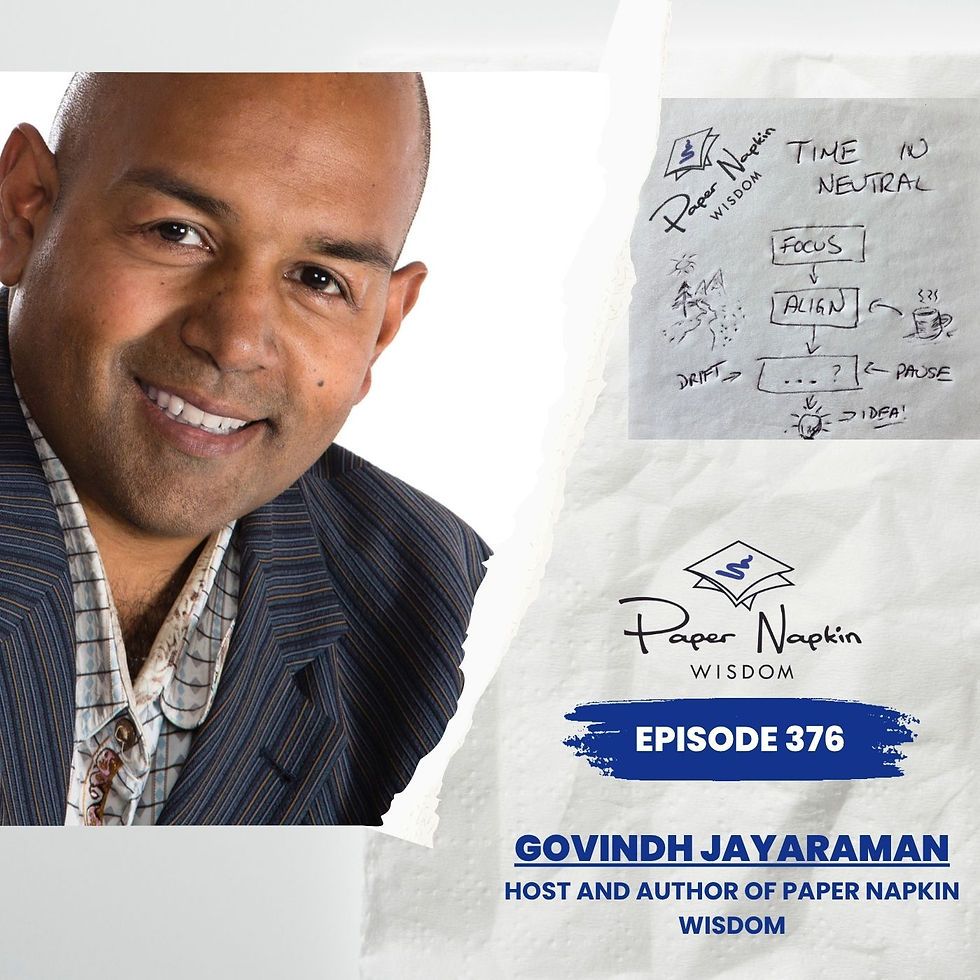
If Govindh had to draw this episode on a napkin, it would look like this:
At the top, the words:
TIME IN NEUTRAL
In the centre, three simple boxes:
FOCUSName what you want.
ALIGNCome back to now.
DRIFTLet the mind connect.
Around the outside would be small drawings. A trail. A bench. A barbell. A coffee cup. A quiet car.
Underneath the boxes, a lightbulb.
Not above them.
Below them.
Because the idea does not come from pressure above. It rises from the quiet below.
At the bottom of the napkin:
The dots need room to meet. Give them neutral.
Why This Matters for Proven Entrepreneurs
For proven entrepreneurs, the challenge is rarely a lack of effort.
They know how to work. They know how to push. They know how to solve. That is often how they built the last chapter.
But the next chapter may not come from more pressure. It may come from a different relationship with the mind.
More room.
More direction.
More calm.
A leader who never enters neutral becomes reactive. Everything is input. Everything is response. Everything is urgency. Eventually, the signal thins.
Time in neutral is where the signal comes back.
It is where confidence gets quiet enough to hear itself. It is where congruence asks, “Is this really mine?” It is where calm becomes a condition, not a performance. It is where contribution starts to point toward the next useful thing.
Maybe the next idea is not missing.
Maybe it is waiting for enough quiet to become visible.
🎙️ Listen to Episode 376 of Paper Napkin Wisdom:
▶ Apple Podcasts: https://podcasts.apple.com/us/podcast/paper-napkin-wisdom-leadership-entrepreneurship-insights/id735345903
▶ Website: https://www.papernapkinwisdom.com
And if this resonated, write it on a napkin.
Share it.
Tag it #PaperNapkinWisdom.
Because ideas small enough to fit on a paper napkin are often large enough to change your world.


Comments